Cherokee,martha Jean Smith Owned Property in Present Day Cherokee Co., Al; Where?
Cherokee Indians. A powerful detached tribe of the Iroquoian language category, formerly belongings the whole mountain region of the south Allegheny Mountains, in southwestward Virginia, western Tar Heel State and South Carolina, Septentrion Sakartvelo, easterly Tennessee, and northeast Alabama, and claiming level to the Ohio.
The Cherokee have got tall held that their tribal name is a corruption of Tsálăgĭ or Tsărăgĭ, the bring up aside which they commonly called themselves, and which may be plagiarised from the Choctaw chiluk-ch'i 'spelunk people', in allusion to the many caves in their mountain country. They sometimes also called themselves Ani´-Yûñ´-wiyá, 'genuine mass,' or Ani´-Kĭtu´hwagĭ, 'populate of Kituhwa,' one of their well-nig important antediluvian settlements. Their Union kinsmen, the Iroquois, called them Oyata'ge'ronoñ, 'inhabitants of the cave res publica' (Hewitt), and the Delawares and connected tribes called them Kittuwa, from the village already noted.They seem to be identical with the Rickohockans, who invaded central Virginia in 1658, and with the antediluvian Talligewi, of Diamond State tradition, WHO were pictured to have been driven southward from the upper Ohio River region by the combined forces of the Iroquois and Delawares.
Cherokee Language
The words has three school principal dialects:
- Elatĭ, or Lower, spoken on the heads of Savannah River, in Southeasterly Carolina and Georgia;
- Middle, spoken chiefly along the Waters of Tuckasegee River, in western North Carolina, and right away the prevailing dialect happening the Eastern United States Cherokee mental reservation;
- A´tăli, Mountain or Upper, spoken throughout most of upper Georgia, eastbound Tennessee, and extreme western North Carolina. The lower berth dialect was the only one which had the r sound, and is now extinct. The amphetamine dialect is that which has been solely used in the native literature of the tribe.
Cherokee Tribe Chronicle
Traditional, linguistic, and archeological evidence shows that the Cherokee originated northwar, but they were found in possession of the south Allegheny region when first encountered by De Soto in 1540. Their relations with the Carolina colonies began 150 years later. In 1736 the Religious (?) Priber started the first missionary work among them, and attempted to organize their government happening a civilized basis. In 1759, under the leadership of A´ganstâ´atomic number 73 (Oconostota), they began war with the English of Carolina. In the Revolution they took sides against the Americans, and continued the fight off almost without separation until 1794. During this period parties of the Cherokee pushed down Tennessee River and hammer-shaped new settlements at Chickamauga and early points about the Tennessee-Alabama line. Shortly after 1800, missionary and learning work was established among theme, and in 1820 they adoptive a regular form of government sculpturesque on that of the United States. Meanwhile large numbers of the more conservative Cherokee, wearied by the encroachments of the whites, had crossed the Mississippi River and made red-hot homes in the wilderness in what is now Arkansas. A year or cardinal after Sequoya, a mixed-blood, unreal the alphabet, which like a sho raised them to the gross of a literary mass.

At the altitude of their prosperity gold was discovered just about the present Dahlonega, Georgia, within the limits of the Cherokee Commonwealth, and at formerly a mighty unrest was begun for the removal of the Indians. After years of hopeless struggle under the leadership of their great foreman, John Ross, they were compelled to submit to the inevitable, and by the treaty of New Echota, Dec. 29, 1835, the Cherokee sold-out their entire remaining territory and agreed to remove beyond the Magnolia State to a body politic there to be set apart for them-the present (1890) Cherokee Nation in Indian Territory. The removal was accomplished in the winter of 1838-39, after respectable hardship and the loss of nearly quarter of their number, the unwilling Indians being driven out away military force and making the long travel on foot 1. On reaching their terminus they reorganized their national government, with their capital at Tahlequah, admitting to comparable privileges the earlier emigrants, known as "of age settlers." A voice of the Arkansas Cherokee had previously gone down into Texas, where they had obtained a grant of land in the eastward part of the DoS from the North American nation politics. The later Texan revolutionists refused to greet their rights, and in spite of the efforts of Gen. Sam Houston, who defended the Indian take, a conflict was precipitated, resulting, in 1839, in the killing of the Cherokee chief, Bowl, with a volumed count of his men, by the Texan troops, and the expulsion of the Cherokee from Texas.
When the main organic structure of the tribe was removed to the westerly, several hundred fugitives escaped to the mountains, where they lived every bit refugees for a clock time, until, in 1842, through the efforts of William H. Thomas, an powerful trader, they received permission to remain on lands put down apart for their economic consumption in westerly North Carolina.
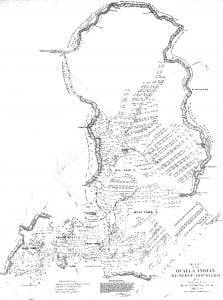
They constitute the present eastern band of Cherokee, residing chiefly happening the Qualla reservation in Boyfriend and Jackson counties, with several outlying settlements.
The Cherokee in the Cherokee Nation were for years biloculate into two aggressive factions, those who had advantaged and those who had opposed the treaty of removal. Hardly had these differences they been adjusted when the civil war burst in on them. Beingness slave owners and surrounded by southern influences, a large part of each of the Five Civilized Tribes of the territory enlisted in the service of the South, while others adhered to the National Government. The district of the Cherokee was overrun in turn by some armies, and the close of the warfare found them prostrated. Aside treaty in 1866 they were readmitted to the tribute of the Agreed States, but obliged to liberate their black slaves and admit them to equal citizenship. In 1867 and 1870 the Delawares and Shawnee, respectively, enumeration unneurotic close to 1,750, were admitted from Kaw River and incorporated with the Nation. In 1889 a Cherokee Commission was created for the purpose of abolishing the tribal governments and opening the territories to white settlement, with the result that after 15 years of negotiation an agreement was ready-made by which the government of the Cherokee Nation came to a final last Mar. 3, 1906: the Indian lands were divided, and the Cherokee Indians, native adopted, became citizens of the United States.
Cherokee Nation
The Cherokee have 7 clans, viz:
- Ani'-wa'`ya (Wolf)
- Ani'-Kawĭ' (Deer)
- Ani'-Tsi'skwa (Bird)
- Ani'-wi'dĭ (Key)
- Ani'-Sah'a'ni
- Ani'-Ga'tagewĭ
- Ani'-Gi-lâ'hĭ
The names of the last 3 cannot represent translated with certainty. There is show that there were anciently 14, which away extinction or absorption have been reduced to their present total. The Wolf clan is the largest and most important. The "seven clans" are frequently mentioned in the ritual prayers and even in the printed Laws of the kin group. They appear to consume had a link with the "heptad bring fort towns" of the Cherokee, delineated by Cuming in 1730 as having apiece a gaffer, whose government agency was transmitted in the female line.
The Cherokee are probably nigh American Samoa many now (1905) as at any period in their history. With the exception of an estimate in 1730, which placed them at about 20,000, near of those up to a recent period gave them 12,000 surgery 14,000, and in 1758 they were computed at only 7,500. The majority of the earlier estimates are probably too Sir David Alexander Cecil Low, as the Cherokee occupied so extensive a territory that only a part of them came in contact with the whites. In 1708 Gov. Johnson estimated them at 60 villages and "at least 500 men" 2 In 1715 they were officially reported to number 11,210 (Upper, 2,760; Middle, 6,350; Lower, 2,100), including 4,000 warriors, and living in 60 villages (Upper, 19; Middle, 30; Lower, 11). In 1720 were estimated to have been reduced to about 10,000, and again in the same year reported at about 11,500, including about 3,800 warriors 3 In 1729 they were estimated at 20,000, with leastwise 6,000 warriors and 64 towns and villages 4.
They are said to have confounded 1,000 warriors in 1739 from smallpox and strange, and they suffered a steady decrease during their wars with the whites, extending from 1760 until after the close of the Revolution. Those in their original homes had again increased to 16,542 at the time of their forced removal to the west in 1838, but lost nearly one-fourth on the journeying, 311 perishing in a steamboat accident on the Magnolia State. Those already in the west, before the remotion, were estimated at about 6,000. The civil state of war in 1861-65 again checked their progress, but they recovered from its effects in a remarkably short time, and in 1885 numbered about 19,000, of whom about 17,000 were in Indian Territory, together with about 6,000 adoptive whites, blacks, Delawares, and Shawnee, while the remaining 2,000 were still in their ancient homes in the east.
Of this eastern band, 1,376 were on Qualla reservation, in Swain and Jackson Counties, North Carolina; about 300 are on Cheowah River, in Graham County, N, while the remainder, all of mixed blood, were scattered complete east Tennessee, north Georgia, and Alabama. The eastern ring lost about 300 by variola major at the close of the civil war. In 1902 there were formally reported 28,016 persons of Cherokee blood, including completely degrees of admixture, in the Cherokee Commonwealth in the Territory, but this includes several thousand individuals erst unacknowledged by the tribal courts.
There were also people in the nation about 3,000 adoptive black freedmen, more than 2,000 adoptive whites, and almost 1700 adopted Delaware, Shawnee, and other Indians. The tribe has a big balance of white admixture than any unusual of the Five Civilized Tribes.
For Farther Subject area
The following articles and manuscripts will shed additional light on the Cherokee as both an ethnological study, and as a people.
- Cherokee Indians – Swanton
- Cherokee Treaties
- Treaty of Nov 28, 1785
- Treaty of July 2, 1791
- Treaty of June 26, 1794
- Accord of October 2, 1798
- Treaty of October 24, 1804
- Treaty of October 25, 1805
- Treaty of Oct 27, 1805
- Treaty of January 7, 1806
- Elucidation of a Convention, September 11, 1807
- Pact of September 8, 1815
- Treaty of Butt o 22, 1816
- Endorsement Treaty of March 22, 1816
- Treaty of September 14, 1816
- Treaty of July 8, 1817
- Reservation Roll of 1817
- Intellect the Reservation Roll
- Treaty of February 27, 1819
- Treaty of May 6, 1828
- Disbursements to Cherokees under the Treaty of May 6, 1828
- Improvements to Annexed Cherokee Lands
- Treaty of Feb 14, 1833
- Agreement of March 14, 1835
- Treaty of August 24, 1835
- Treaty of December 29, 1835
- Treaty of August 6, 1846
- Agreement of September 13, 1865
- Treaty of July 19, 1866
- Treaty of April 27, 1868
- Cherokee Amerindian language Chiefs
- Cherokee Amerindian Chiefs and Leaders
- Cherokee Indians Emplacemen
- Kansas Indian Tribes – Swanton
- Bluegrass State Indian Tribes – Swanton
- Alabama American Indian Tribes – Swanton
- Arkansas Indian Tribes – Swanton
- Empire State of the South Indian Tribes – Swanton
- North Carolina Indian Tribes – Swanton
- South Carolina Indian Tribes – Swanton
- Oklahoma Indian Tribes – Swanton
- Virginia Indian Tribes – Swanton
- West Virginia Amerindic Tribes – Swanton
- Cherokee Indian Rolls
- Reservation Roll
- Understanding the Reservation Roll
- Disbursements to Cherokees under the Pact of May 6, 1828
- Trail of Crying Roll, 1835
- Old Settlers Roll, 1851
- Drennen Drum roll, 1852
- Act of Congress Curlicue, 1854
- Hester Roll, 1883
- Index to Net Roll, 1889-1914
- Final Roll, 1889-1914
- Apprehension the Final (Dawes) Rolls
- Wallace Roll, 1890 (Cherokee Freedmen)
- Kern Clifton Roll, 1897 (Cherokee Freedmen)
- Guion Alton Glenn Miller Roll, 1909 (Eastern Cherokee)
- Bread maker Roll, 1924 (Eastern Cherokee)
- Enrollment of Five Civilized Tribes, 1896
- Reservation Roll
- Cherokee Indian Bands, Gens and Clans
- 1835 Henderson Roll
The following is the 1835 Cherokee East of the Mississippi Census or other called the Henderson Roll. This is only an index of the names. Researchers should consult the full roll in dictate to get Sir Thomas More limited information along each family listed. In 1835, the Cherokee Nation contained almost 22,000 Cherokees and near 300 Whites connected aside marriage ceremony. This roll enumerates 16,000 of those citizenry under 5,000 different families. - 1880 Cherokee Nation Census
- Sacred Formulas of the Cherokee
- Amerind Missions of the Southern States
- Native American Mailing Lists
- Indian Tribe Mailing List by Location
- Indian Roll Posting List
- Indian Cemetery Mailing Listing
- Oklahoma Indian Tribal Schools
- Cherokee Orphan Asylum
- Legal Status of Indians, 1890
- A 100 of Dishonor
- The Cherokee Indians
- The Cherokee Who Invented the Cherokee Alphabet
- How to Register for your CDIB Card
- Native American Land Patents
- 1828 Abstracts of the Cherokee Phoenix
- Abeel and Allied Families
- An Overland Journey to the W
- Cherokee Nation of Indians
- Cherokee Proposals for Cession of their Land
- Chronicle of the Cherokee Indians, Legends and Folklore -Emmet Starr
- Biographies of the Cherokee Indians
- Genealogies of the Cherokee Indians
- Red Bird Smith and the Keetoowah Beau monde
- The Cherokee of the Smoky Mountains
- Eastern Cherokee of North Carolina
- Eastern Band of Cherokee
- Eastern Cherokee Schools
- Eastern Band of Cherokee Real Outline
- Eastern Cherokee in the 11th US Census
- Middle Atlantic Cherokee Enumeration, 1800
- Act of Union betwixt Eastern and Western Cherokee, 1838
- Native Uprisings Against the Carolinas (1711-17)
- Free US Indian Census Schedules 1885-1940
- Eastern Cherokee Amerindic Agency
- 1898-1899 Southeastern Cherokee Indian Agency Census
- 1904 Eastern Cherokee Indian Agency Census
- 1906 Eastern Cherokee Indian Representation Nosecount
- 1909-1912 Eastern Cherokee American Indian Agency Census
- 1914 Eastern Cherokee Indian Agency Census
- 1915-1922 Northeastern Cherokee Indian Representation Census
- 1923-1929 Easterly Cherokee Indian Agency Census
- 1930-1932 Eastern Cherokee Indian Agency Census
- 1933-1939 Eastern Cherokee Indian Delegacy Nose count
- Eastern Cherokee Amerindic Agency
Citations:
- See Trail of Tears Roll for a list of those participating in the march[↩]
- Rivers, So. Car., 238, 1856.[↩]
- Gov. Johnson's Repp. in Rivers, So. Car., 93, 94, 103, 1874.[↩]
- Stevens, History of Georgia, I, 48, 1847[↩]
Cherokee,martha Jean Smith Owned Property in Present Day Cherokee Co., Al; Where?
Source: https://accessgenealogy.com/native/cherokee-tribe.htm
0 Response to "Cherokee,martha Jean Smith Owned Property in Present Day Cherokee Co., Al; Where?"
Post a Comment